If you've missed the other posts in this blog, you can find them all here on the main page.
Before we left for Malaysia, we binge watched YouTube videos to learn all we could about the people, the culture, the food, where to go and what to see, how to avoid major cultural faux pas, etc, etc. All this in an effort to be optimally prepared to take it all in and get the most out of our three week visit.
One of the videos I watched was all about how to eat your food in Malaysia. Now, that might seem like a silly topic, but when you want to have the full cultural experience details like this are important.
Given that there are three main ethnic groups in Malaysia, namely Malay, Chinese and Indian, there are three main methods of getting the food from the plate or bowl into your mouth. As I mentioned in Part 1 of this food series, there are many more culinary options besides these three, but they are the main ones so I'll just focus on those for now.
Chinese food is often eaten from a bowl with chopsticks and a Chinese spoon. One picks up the "bits" with chopsticks and either puts them directly into the mouth if the dish is "dry" (meaning there is no broth), or alternatively they can be put onto the spoon to be eaten along with some broth if the dish is "wet" (meaning it's swimming in a broth).
Of course, there's a lot of variety in the types of dishes, and many are also eaten from a plate with only chopsticks, but if you've ordered something with broth, Chinese spoon + chopsticks is the way to go.
Here's Gerry, about to tuck into breakfast. You can see we both have chopsticks at the ready, and Gerry's pink spoon is just visible in his orange bowl (how 'bout those colours, eh?).
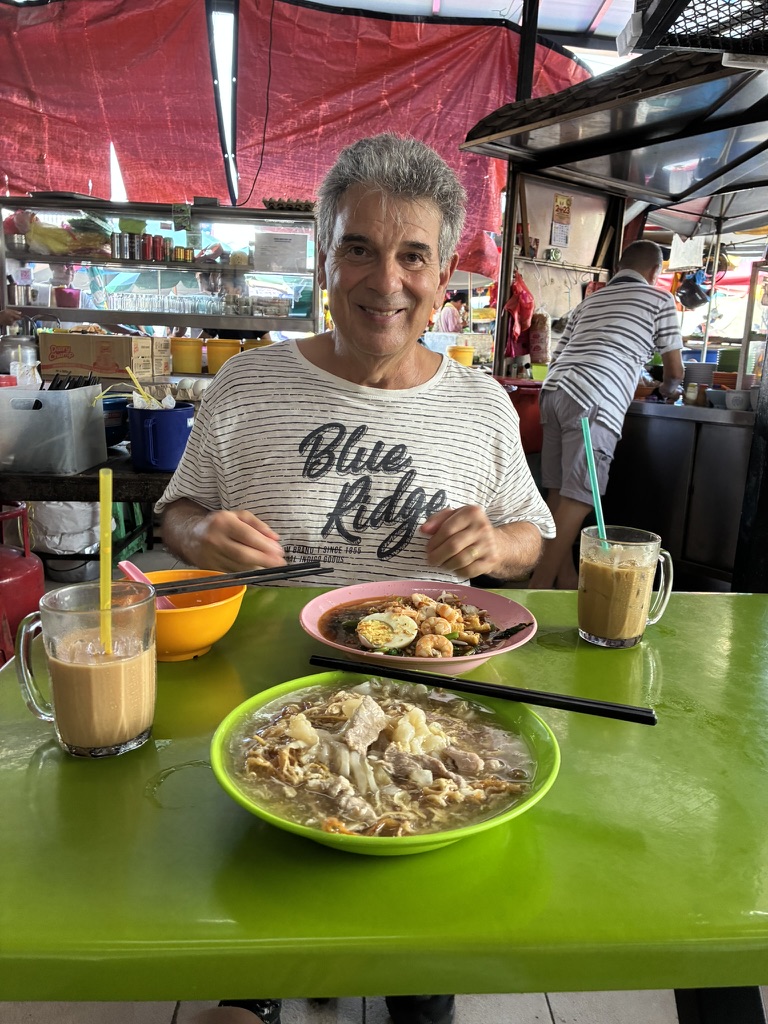
This was actually our last day in KL and we had ventured out to a Chinese wet market in a local neighbourhood to check it out before getting some breakfast. It was definitely a point-and-smile ordering experience, though one younger fellow did speak a bit of English and he helped us order.
He also went to the trouble of finding and washing forks and spoons to present to us. We thanked him but said we'd prefer the chopsticks. I think he was fairly impressed that a couple of old folks from Canada could manage them pretty well.
Indian food, on the other hand, is traditionally eaten with the fingers. You pick up a blob of rice and kind of dunk it into your dahl or veggies, mop some up, then plop the whole thing into your mouth. Importantly, one must use only the right hand to do this, as the left hand is traditionally used to clean the other end of the digestive tract, if you get my drift.
While we observed quite a few locals expertly eating their lunch in this way, we weren't inclined to follow suit, at least not with rice. It seemed like it would take some practice to eat a meal using a only a handful of rice, so we figured it would be much less embarrassing to just use spoon and fork. This method is also quite acceptable (see more on this below) so we played it safe as far as rice dishes were concerned.
Anything served with bread, however, was a different matter. Take this breakfast of roti (a very thin, tender bread, often filled with yummy things - in this case I believe it was cheese and garlic), and dahl (spiced lentil soup/gravy).
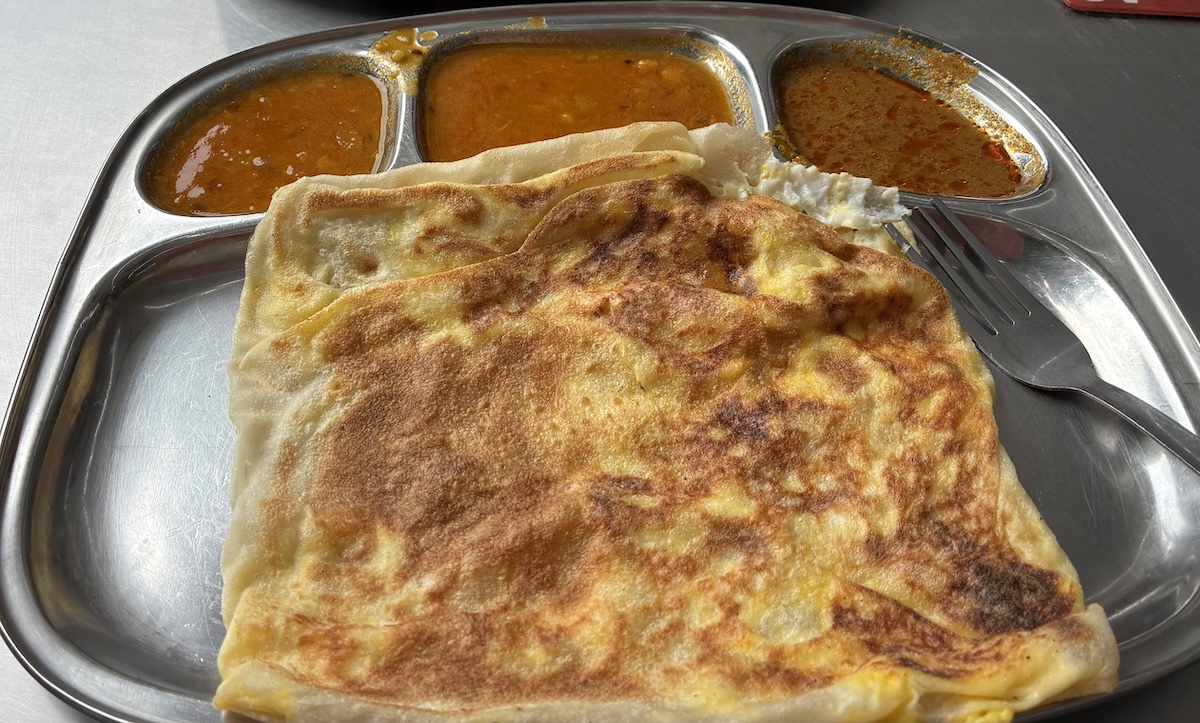
While it was served with a fork, I assumed that was only because we were obviously Westerners and the assumption therefore was that we required a fork to eat a meal. Wrong!
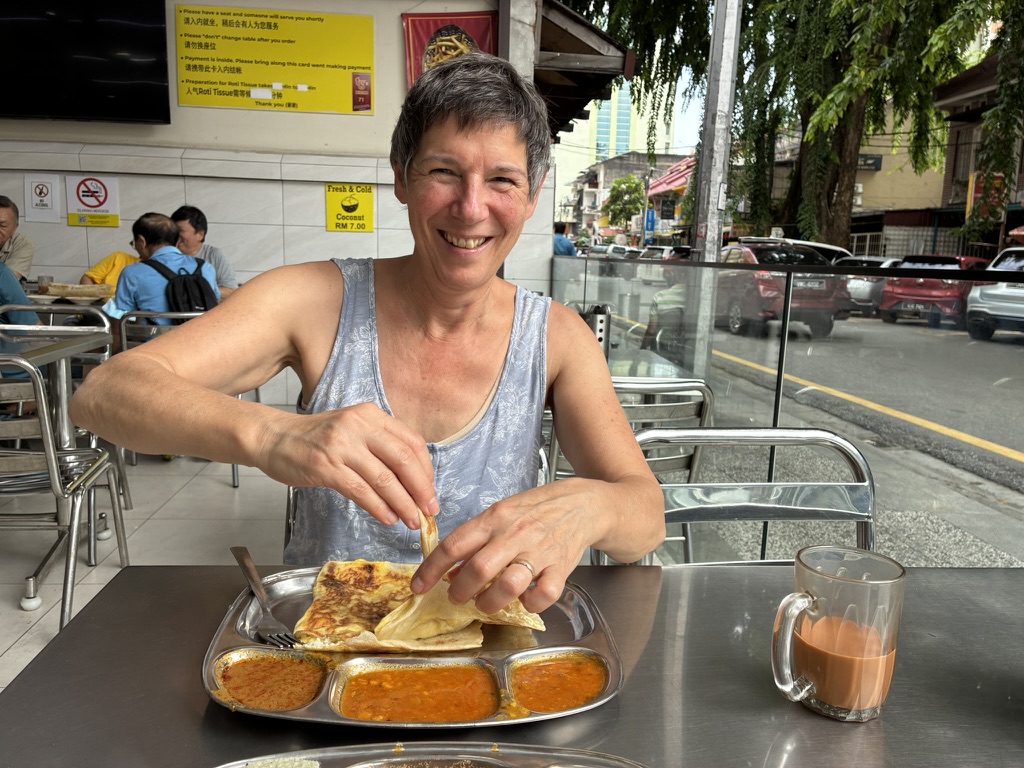
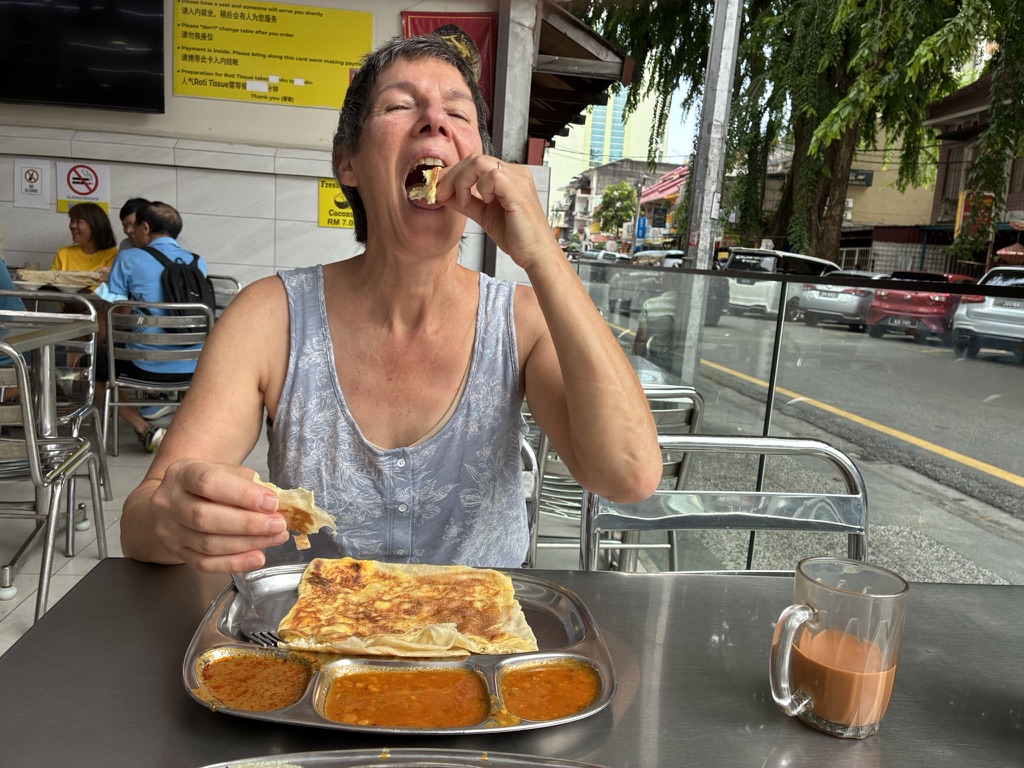
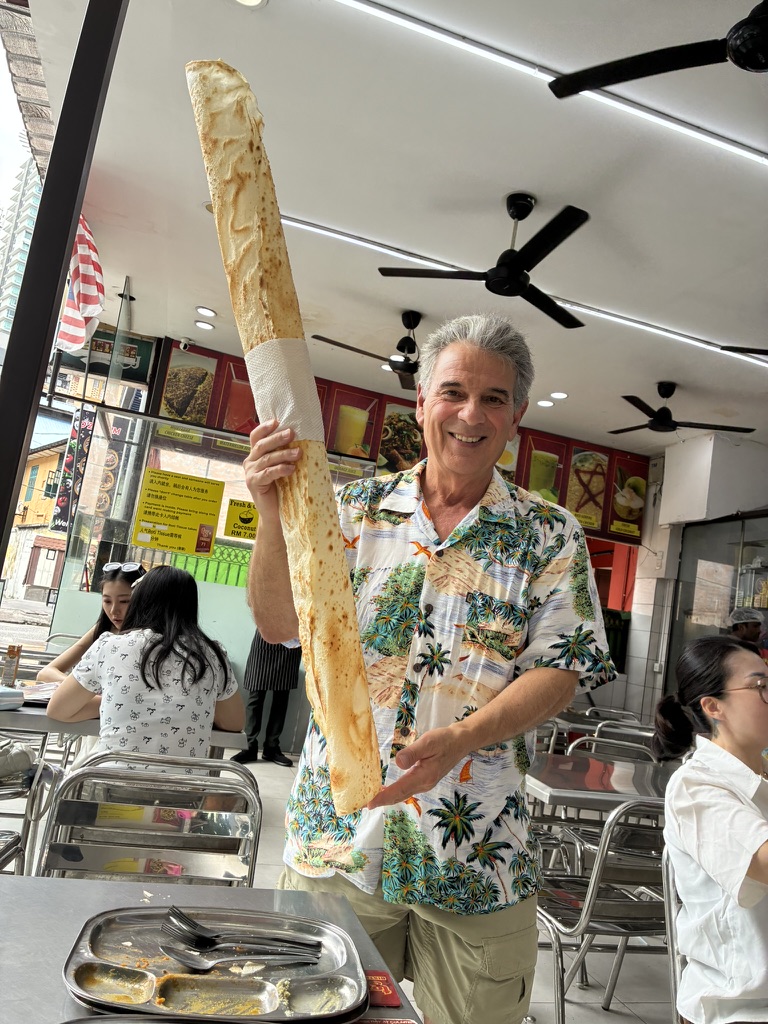
Then there's something called roti tissue, a special treat we'd never heard of before. It's basically an enormous roti (can't imagine how big the griddle must be!) made by spreading the batter very thin and cooking so it's just soft enough to be rolled up, then it crisps up after it's off the heat. The result is this super fun and very photo-worthy food item that can really only be eaten with the hands. Fortunately, it's not at all messy and the worst that can happen is you'll need to sweep the floor when you're done eating it.
Finally, Malay food is eaten with spoon and fork, which is also the method most commonly used if the meal is other than Chinese or Indian, or is perhaps a combination meal.
I say "spoon and fork" vs "fork and spoon" because the spoon is actually the main eating utensil. The food is scooped up with a spoon, and when you get down to the last few bites you use the fork to help push the last bits of food onto the spoon.
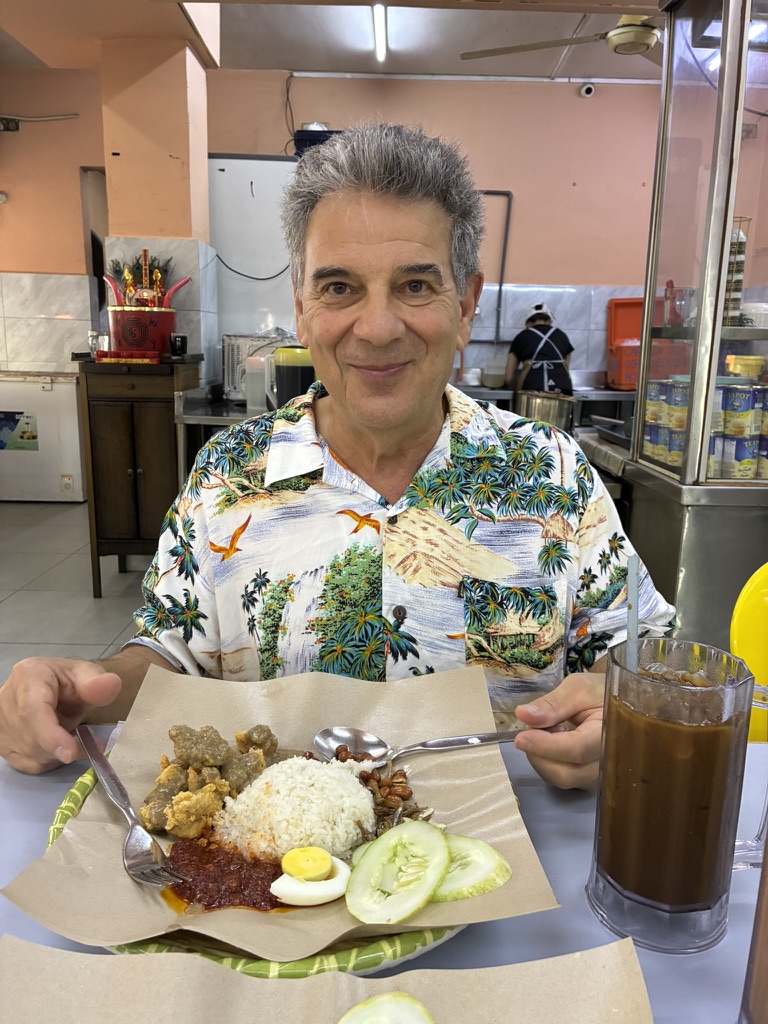
Here's Gerry demonstrating while eating our first breakfast in KL, Nasi Lemak, a traditional dish of rice, egg, and a bit of raw veggie, garnished with roasted peanuts and spicy sauce, and optionally served with chicken in various forms.
We haven't yet been given a knife to eat a meal, even in a fancier restaurant serving Yemeni food. I'll be sure to highlight that place in a future food post, as it's worthy of its very own blog post!
Yes! You are welcome to share this blog with others who might enjoy it.
If you want to be notified whenever there's a new post, just click the Subscribe via email link down at the very bottom of the actual blog post (not the email).
Hi, I’m a friend of your Dad. Just want you to know how much I enjoyed your account of dining in Malaysia. I suspect you have inherited Derek’s forte for writing. Cheers, Nora
So impressed with the amount of prep before traveling. In days of yore when it was still a big deal to go to Europe and before p.c.s, we did our research via travel books and foreign newspapers from the library. I loved that part almost as much as the traveling itself. I appreciate that you demonstrated goodwill by leaving your North American eating modes at home and joining locals in theirs. Good on ya!
library eh